I have a personal reason for identifying with the Symposium story of soul-mates. The story goes that in the begginning, people were attatched to eachother. Really, though, we only think of them as attatched. They were whole. There were men, women, and androgynous beings. But the gods couldn't handle the humans so they were split down the middle and sewed up. The belly-button is where they were attatched. Now we are all looking for our other half, male or female depending upon who we used to be.
I like this story because ever since I was young I have played with my belly-button. I pet it, and find it soothing. I used to, and still do, do this when my tummy hurts. My boy friend thinks it's weird. I don't blame him.
But this is why I like the story.
Wednesday, April 4, 2007

"THIS IS SPARTA!"
So, like every person I've spoken to so far, I loved the movie 300. Due to my experiences in Classical Lit class, however, I'd like to think that I enjoyed it a little more than most. First of all, it was a myth, mythos, a tale. One told by the sole survivor of the 300 men. The actions of all characters were enhanced as in a tale, the wolf's eyes, for example, the ugly old priests on the mountain, and the height of the Persian King are only a few examples of the mythic quality of the movie. They also mentioned "hubris" the tragic downfall that comes from assumed greatness and imperviousness. In short, assuming you are a god and are not suseptable to the pitfalls of humanity. I liked that part.
The King of Sparta faced the delima of Individual vs Society because he could not disobey the oracle or the counsil's decision to hold a festival to the gods instead of defending hearth and home, yet he did. And that is why he fought with 300 "volunteers" instead of the army.
His wife faced the battle of Man vs Woman because she was not welcomed to speak in the arena on her husband's behalf soley based on her sex. She could also not fight with him nor ask him not to.
The general who lost his son went mad when he died. So he was haunted by the dead.
In short, though it's not "factual"...and what good story is?...300 was a good movie with many classical elements.
The King of Sparta faced the delima of Individual vs Society because he could not disobey the oracle or the counsil's decision to hold a festival to the gods instead of defending hearth and home, yet he did. And that is why he fought with 300 "volunteers" instead of the army.
His wife faced the battle of Man vs Woman because she was not welcomed to speak in the arena on her husband's behalf soley based on her sex. She could also not fight with him nor ask him not to.
The general who lost his son went mad when he died. So he was haunted by the dead.
In short, though it's not "factual"...and what good story is?...300 was a good movie with many classical elements.
Monday, March 26, 2007
The Courtesean and the Anadonis
Let me begin by saying that I have nothing against The Courtesean. I liked Nicole Kidman's role in Mulin Rouge; I read and enjoyed Memoirs of a Geisha; and I love the mystery of Maralyn Munroe (aka Norma Jean). But I despise Anna Nicole smith and think her undeserving of the title courtesean. I would call her, much more vulgarly, a gold digging whore. Despite her title as Playmate of the Year, she was a stripper, who married for money and did nothing with herself when her husband died. She was on drugs, she was a joke. She was a joke until her death made her a victim. And this is what I hate, that people are trying to make her death tragic. I even heard from some media source or other that she died of an "accidental drug overdose."
Now, this is just me, but I can't see the tragedy in this. It's almost a relief: she was finally put out of her drunken/drugged out embearassment of a life.
I think of a courtesean as a woman who had no other options and capitalized on her value as a woman. The tragedy of the courtesean is that she never gains her freedom and cannot live her own life. Anna Nicole wasted her freedom and her life.
Elvis died of a drug overdose on the toilette: a true Adonis. No one thinks the less of him. He is The King.
Conclusion: even I play into the double standard that has been set. Elvis died on the crapper as a hero; Anna Nicole over dosed and I find it a release. (Steiner rears his ugly head once again to point out the conflict of Man vs Woman).
Now, this is just me, but I can't see the tragedy in this. It's almost a relief: she was finally put out of her drunken/drugged out embearassment of a life.
I think of a courtesean as a woman who had no other options and capitalized on her value as a woman. The tragedy of the courtesean is that she never gains her freedom and cannot live her own life. Anna Nicole wasted her freedom and her life.
Elvis died of a drug overdose on the toilette: a true Adonis. No one thinks the less of him. He is The King.
Conclusion: even I play into the double standard that has been set. Elvis died on the crapper as a hero; Anna Nicole over dosed and I find it a release. (Steiner rears his ugly head once again to point out the conflict of Man vs Woman).
Wednesday, March 21, 2007
sex and the polis
While reading Lysistrata I suddenly realized why the play seemed so familiar. I believe that Samantha Jones, Carrie Bradshaw, Charlotte York, and Miranda Hobbs have had similar conversations about bikini waxes, the ideocy of men, and the power of sex.
When the show first appeared on HBO, critics and viewers alike raved about the audacity of the show to portray women as the equal of men when it came to sexual desires. As seen from Lysistrata, this is not a revolutionary post-feminisim idea. Sex and the City was one of the country's top commedies for six seasons and Lysistrata continues to be taught as an example of comedy.
as always, Girls Rule
When the show first appeared on HBO, critics and viewers alike raved about the audacity of the show to portray women as the equal of men when it came to sexual desires. As seen from Lysistrata, this is not a revolutionary post-feminisim idea. Sex and the City was one of the country's top commedies for six seasons and Lysistrata continues to be taught as an example of comedy.
as always, Girls Rule
The Triple Goddess
Well, classic literature is adding new demention to everything in my life...unfortunately it's creeping into my "mindless time". The other day I was watching the loquacious show Gilmore Girls when I realized that the three goddesses were represented in the show.
Rory, the maiden: Rory is the epitome of the waifish, chaste, breathy-voiced, innocent girl with big blue doe-eyes.
Lorelai, the mother: Lorelai is Rory's mother, her namesake, and she was split when she gave birth to Rory at the age of sixteen. Unable to bear her mother's domination any longer, Lorelai runs away from home after graduating from high school and begins her new life completely separate from her mother with Rory. She has no husband, so she cannot hold the position of the wife, and she gave-up her role as daughter when she left her mother's house. She is a mother, but she is still struggling with her own battles as a woman.
Emily, the crone: Oppressive, passive-aggressive, and completely selfish, she is Lorelai's mother, the older crone.
Rory, the maiden: Rory is the epitome of the waifish, chaste, breathy-voiced, innocent girl with big blue doe-eyes.
Lorelai, the mother: Lorelai is Rory's mother, her namesake, and she was split when she gave birth to Rory at the age of sixteen. Unable to bear her mother's domination any longer, Lorelai runs away from home after graduating from high school and begins her new life completely separate from her mother with Rory. She has no husband, so she cannot hold the position of the wife, and she gave-up her role as daughter when she left her mother's house. She is a mother, but she is still struggling with her own battles as a woman.
Emily, the crone: Oppressive, passive-aggressive, and completely selfish, she is Lorelai's mother, the older crone.
Metemphychosis and Elvis Presley
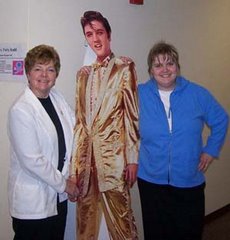
My boyfriend asked me the other day if I was reading a book about Elvis. "Um...not exactly," was my reply. The truth is, I didn't know for sure how to explain why Elvis graced the cover of The Baccae because I still thought of Dyonisis as the pudgy drunk god in "Fantasia". But Dyonisis, the god usually associated with wine and parties, is also the patron god of Drama and thus performance. He drives thebian women crazy, sending them into a frenzie which Pentheus fears to be an orgie. He is the god of fun but he has a dark side as well, as seen when he sends the young king to his death by the hands of his mother.
So, to connect the dots, Elvis - the celebrated hearthrob of the fifties, who's title is The King of Rock and Roll - died on the toilette after gaining weight and wearing gold jump suits. Definately a dark side. And who could drive young girls crazy? Elvis Presley. I'm sure that my grandmother still harbors a secret, undying love for him. But the most common defining attribute is that Elvis was a performer. (I should say, "is"...but I'll get to that in a moment) The public knew him only as a performer, as the heart throb, the rebel rocker, The King. And even though some people can name his parents and have seen his birthplace and been to his museum, Elvis, who he really was, is unknown to the public...even if the public crowned him.
But the most important connection...I'll call it the real connection...is that Dyonisis is also Adonis. An Adonis is a beautiful young man who dies a horribly tragic premature death. Examples are James Dean (*sigh*), Elvis, Steve McQueen, Jim Morrison, etc.
So, to connect the dots, Elvis - the celebrated hearthrob of the fifties, who's title is The King of Rock and Roll - died on the toilette after gaining weight and wearing gold jump suits. Definately a dark side. And who could drive young girls crazy? Elvis Presley. I'm sure that my grandmother still harbors a secret, undying love for him. But the most common defining attribute is that Elvis was a performer. (I should say, "is"...but I'll get to that in a moment) The public knew him only as a performer, as the heart throb, the rebel rocker, The King. And even though some people can name his parents and have seen his birthplace and been to his museum, Elvis, who he really was, is unknown to the public...even if the public crowned him.
But the most important connection...I'll call it the real connection...is that Dyonisis is also Adonis. An Adonis is a beautiful young man who dies a horribly tragic premature death. Examples are James Dean (*sigh*), Elvis, Steve McQueen, Jim Morrison, etc.
Tuesday, March 20, 2007
the living vs the dead
Last month, my sister's friend, an eighteen-year-old high school senior, committed suicide by hanging herself off of a bridge in her back yard. Before she died, she text messaged a friend some cryptic words and the friend, who did not know the girl's intentions, told the girl's parents. Her dad went down to the creek behind her house and saw her body. He tried to recessitate her, but her "knot intrinsicate" had come undone.
The real tragedy of such a hasty exit of the world, especially in the circumstances of this family, was the pain she left behind for all of her friends and her parents (who were only blessed with with one child).
After the initial shock of her friend's departure, my sister became very angry. The only thing I could think of to console my sister was that this girl - an honors student, and a legal adult - while desperate was not ignorant. She was very miopic in her purpose, and whether it was an act of vengance, self-pity, or despair, she knew what she was doing. But the living, the pained persons she left behind, will never know her motives; but they will be haunted by her untimely death.
The real tragedy of such a hasty exit of the world, especially in the circumstances of this family, was the pain she left behind for all of her friends and her parents (who were only blessed with with one child).
After the initial shock of her friend's departure, my sister became very angry. The only thing I could think of to console my sister was that this girl - an honors student, and a legal adult - while desperate was not ignorant. She was very miopic in her purpose, and whether it was an act of vengance, self-pity, or despair, she knew what she was doing. But the living, the pained persons she left behind, will never know her motives; but they will be haunted by her untimely death.
Subscribe to:
Posts (Atom)